Our paper on chip-based multi-NV quantum sensing is published in Nature Communications
Published:
Our work on “Photonic-integrated quantum sensor array for microscale magnetic localisation” is today published at Nature Communications! This is the third project I led in my PhD, supported by the strong team at the University of Bristol and QET Labs!
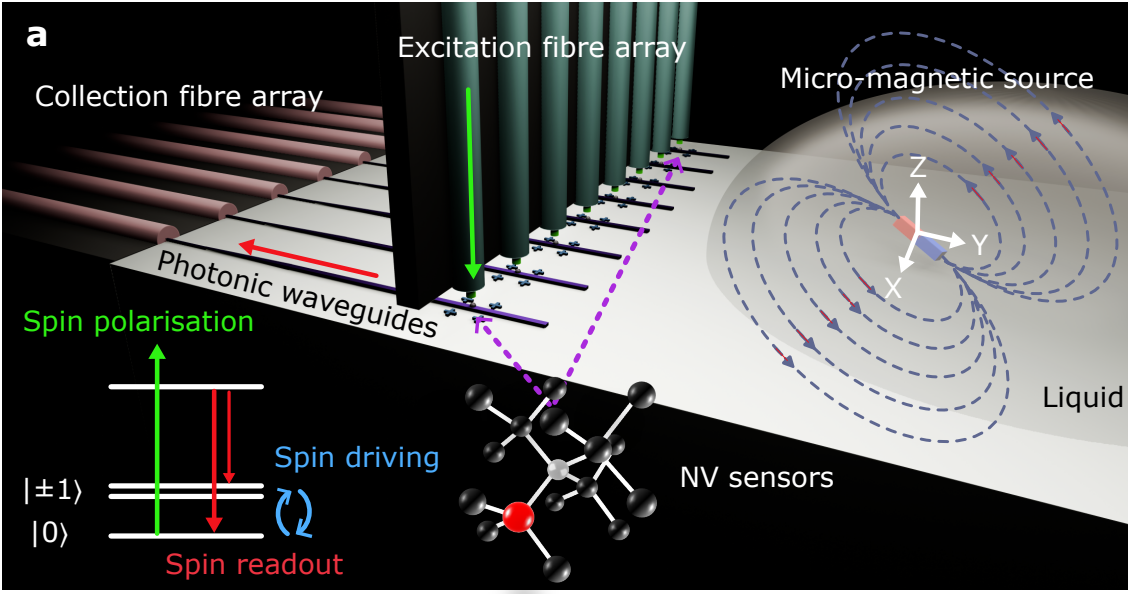
Nitrogen-vacancy centres (NVs) are promising solid-state nanoscale quantum sensors for applications ranging from material science to biotechnology. Using multiple sensors simultaneously offers advantages for probing spatiotemporal correlations of fluctuating fields or the dynamics of point defects. In this work, by integrating NVs with foundry silicon-nitride photonic integrated circuits, we realise the scalable operation of eight localised NV-ensemble sensors in an array, with simultaneous, distinct readout of the individual sensors. Using the eight NV sensors and machine-learning methods for multi-point magnetic field reconstruction, we demonstrate microscale magnetic localisation of a 30 μm-sized needle tip. Experimentally, the needle tip can be localised with an error below its dimension and tracked dynamically with high fidelity. We use simulations of microrobot-relevant magnetic profiles as an application-motivated case study to quantify the operating bounds and requirements for translation and rotation tracking. By moving multi-NV localisation from bulk-optical addressing to a fibre-addressed, guided-wave, multi-channel architecture with simultaneous distinct readout, this work provides a scalable architecture towards magnetic localisation in optically inaccessible environments.