
Crosstalk-mitigated microelectronic control for optically-active spins
Published in Physical Review Applied, 2026
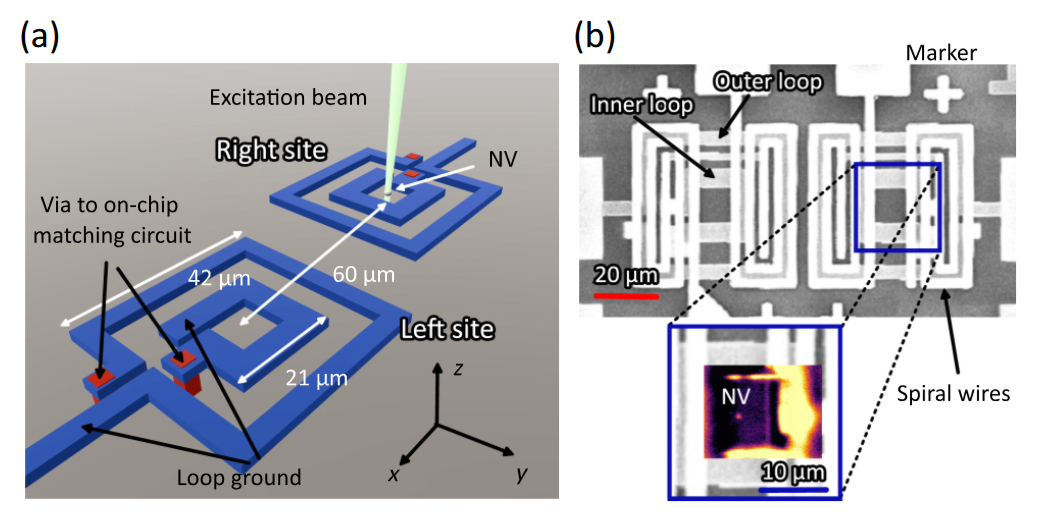
To exploit the subnanometer dimensions of qubits for large-scale quantum information processing, corresponding control architectures require both energy and space efficiency, with the on-chip footprint of unit-cell electronics ideally being micrometer scale; however, the spin coherence of qubits in close packing is severely deteriorated by microwave crosstalk from neighboring control sites. Here, we present a crosstalk-mitigation scheme using foundry microelectronics to address solid-state spins at sub-100-μm spacing without the need for qubit detuning. Using nitrogen-vacancy centers in nanodiamonds as qubit prototypes, we first demonstrate 10-MHz Rabi oscillations at milliwatt-level microwave power. By implementing active cancellation, we then demonstrate that the crosstalk field from neighboring lattice sites can be reduced to undetectable levels. We finally extend the scheme to show increased qubit control, or, effectively, enhanced spin coherence under crosstalk mitigation. Compatible with integrated optics, our results present a step toward scalable control across quantum platforms using silicon microelectronics.
Recommended citation: Hao-Cheng Weng, John G. Rarity, Krishna C. Balram, and Joe A. Smith, Crosstalk-mitigated microelectronic control for optically active spins, Physical Review Applied 25, 024025 (2026).
Download Paper